What changed
Performance is the two-seat base, with Thrust and Rocket listed as augments. Thrust emphasizes rear cold-gas propulsion; Rocket is single-seat and invite-only, with a public-road restriction. The sub-one-second acceleration statement and flight capability belong to different descriptions, rather than a promise attached to every reservation.
The important change is the product map
The current Tesla Roadster page presents Performance as the base and Thrust and Rocket as augments. It describes road, race and air-oriented configurations with different seating and access. These names are therefore not interchangeable labels for one specification sheet.
That changes how the news should be read. A viral summary can combine acceleration, seating and flight into an apparently universal package. A more useful interpretation starts by identifying the configuration. Before asking how fast Tesla’s thruster-equipped car is, establish whether the claim concerns Performance, Thrust or Rocket and which conditions accompany it.
| Path | Seats and orientation | Distinction | Access wording |
|---|---|---|---|
| Performance | Two seats; road oriented | Active aero and multi-mode suction | By reservation |
| Thrust augment | Two seats; race oriented | Rear cold-gas thrusters for acceleration | Limited release |
| Rocket augment | One seat; air oriented | Perimeter thrusters for additional motion axes | Invite only; regional limits |
Thrust adds a force path beyond the driven wheels
Tesla connects the Thrust description’s sub-one-second 0–60 claim to rear cold-gas thrusters. The conceptual shift is a propulsion path in addition to the wheels. That differs from simply adding more electric-motor output, and it creates separate questions about stored gas, control and operating conditions.
Do not turn that wording into an independently measured 0–100 km/h result for every version. Using NIST’s conversion factors, sixty mph is approximately 96.56 km/h, so the endpoint differs. The statement also remains a manufacturer capability claim. Timing conditions, repeat attempts and production consistency need more evidence, discussed in our acceleration and production analysis.
Rocket attracts attention and needs its own boundaries
The Rocket description covers forward, upward and rotational movement, alongside single-seat access, invitations and regional limits. Tesla also includes a public-road restriction. Those qualifications are part of the story, rather than optional fine print to remove from a dramatic headline.
Editorially, this should be understood as a specialized proposition with its own operating requirements. It does not establish that a commuter flying car has been delivered. A controlled demonstration, a claimed capability and ordinary customer operation answer different questions. Retain the stated boundaries instead of allowing an impressive image to settle all three.
Three headlines imply three different questions
The road proposition
Examine the base driving configuration without importing every capability advertised for an augment.
The track proposition
Ask how propulsion, tires and aerodynamics cooperate and which test conditions apply.
The flight proposition
Treat operating limits, seating and controls separately instead of borrowing a road-car label.
The engineering that the thruster headline can obscure
The product page also emphasizes active aerodynamics and a multi-mode suction system. Fans and underbody sealing address downforce, while cold-gas propulsion concerns another source and direction of force. Calling every feature rocket acceleration obscures the work being done between the tires and the surface.
That interaction is an important reason to follow the product beyond a peak number. Several systems must work together rather than produce isolated headline figures. Our thrusters, suction and active-aero explainer separates their roles without treating a valid physical principle as independent certification of this particular car.
Keep the event date and product status together
Tesla’s official event announcement scheduled the stream for Thursday evening in the United States. This article records the website and technical communications checked on October 16 in Beijing. October 15 locally and October 16 in China do not refer to two separate reveals. We rely on accessible primary material and do not present unplayable media as a witnessed demonstration.
The next meaningful development should add evidence: final configurations, defined test conditions, operating boundaries or delivery progress. A different edit of the same demonstration does not by itself advance the product’s status. The chronology below separates what was announced from what remains to be established.
Three stages of the available information
- Event announcement
October 15 evening in the U.S.
Read the official local schedule separately from the Beijing calendar date.
- October 16 review
Configurations separated on the website
This article records the current product distinctions and qualifications.
- Still to follow
Testing, final configuration and delivery
These are observation points, not an invented production timetable.
What deserves attention after the reveal?
The U.S. reservation page offers Performance and Thrust choices while labeling Rocket invite-only. A reservation entry establishes a process, rather than a particular buyer’s final configuration, delivery date or receipt of a vehicle. This article does not equate reservation payments with a complete vehicle price or recommend a payment decision.
For readers following technology, Roadster is a striking example of the difference between demonstrating an extreme capability and defining a usable product. The valuable question is how the engineering becomes repeatable and well specified. Enthusiasm can coexist with leaving unresolved details open instead of announcing that every implementation problem has already been solved.
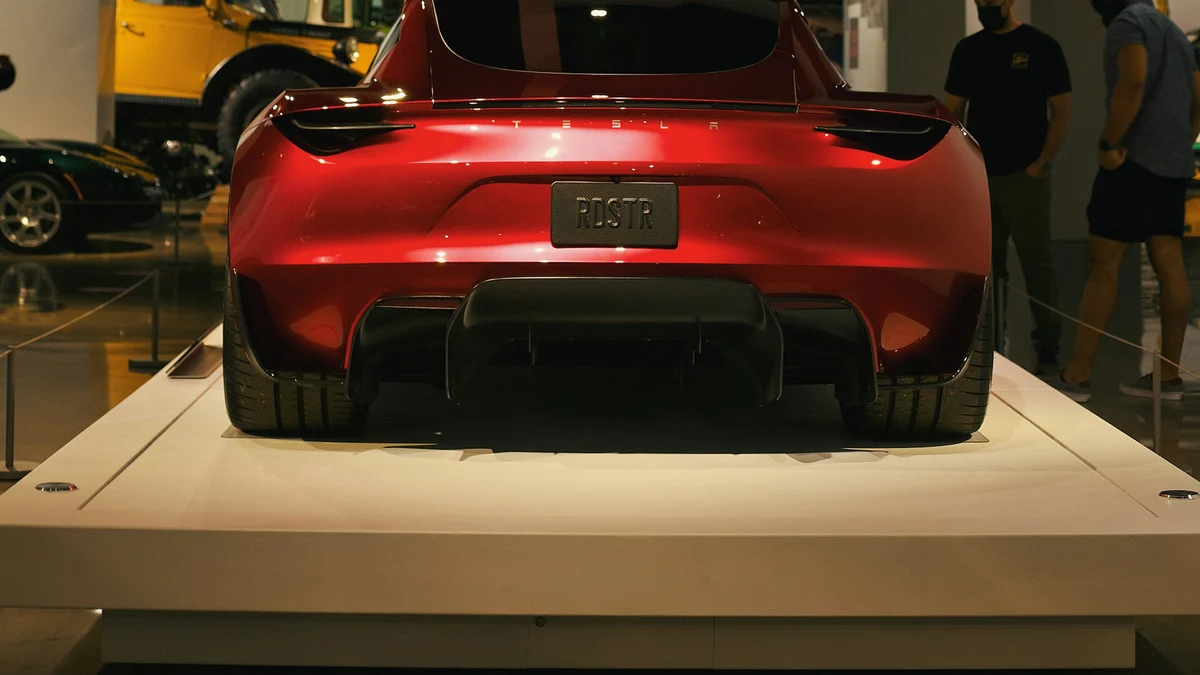
The cover is a photographer’s 2021 image of an earlier Roadster prototype. It is historical illustration, not a photograph of this reveal or the new vehicle.
Common questions
Are these three delivered production cars?
No. The current page describes a Performance base and two augments with different access arrangements. We have not established that all three are being delivered to ordinary customers.
Does a Performance reservation include flight?
Do not infer that. Tesla places flight-related capabilities in Rocket’s description, with single-seat, invitation and regional qualifications. Read the actual configuration separately.
Are the capabilities independently tested here?
No. Configuration facts and capability statements come from official pages and communications. This article provides reporting and editorial analysis, rather than vehicle, track or flight testing.