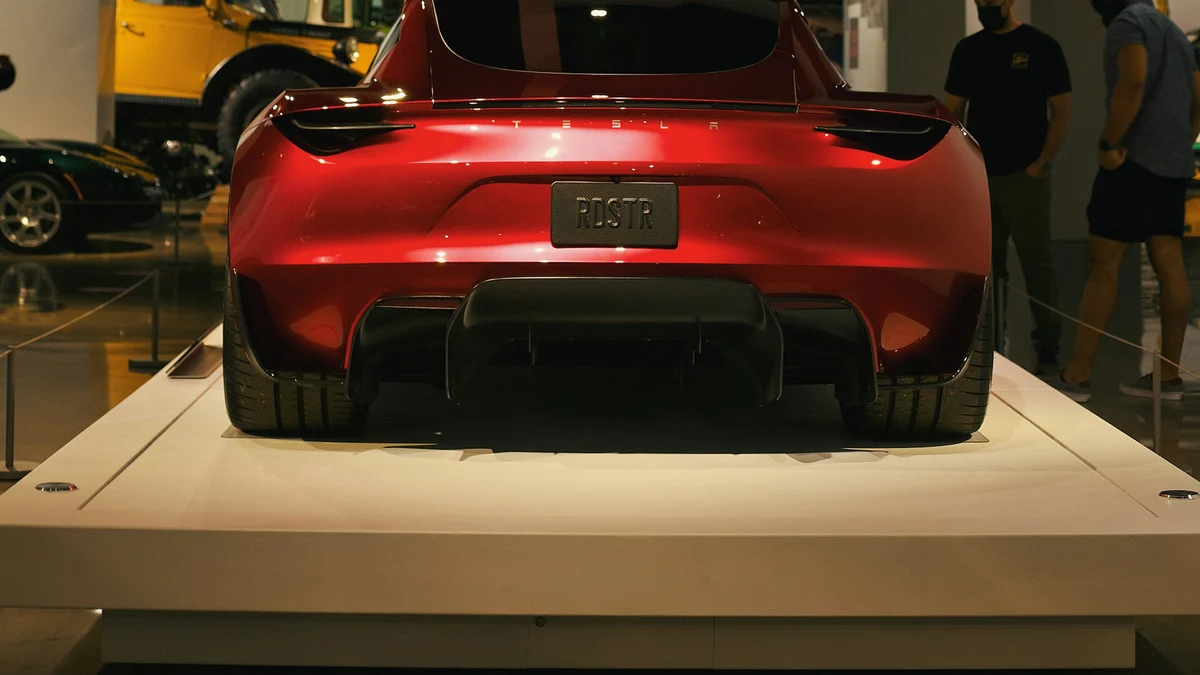
What changed
On Tesla’s page checked on October 16, 2026 in Beijing, the Thrust statement concerns 0–60 mph in under a second. Sixty mph equals 96.56064 km/h, so it is not automatically a tested 0–100 km/h result. A product statement, reservation process, independent test and customer delivery each require different evidence.
A headline number needs its conditions
The current Tesla Roadster page places the acceleration statement within its description of the Thrust augment. It is a manufacturer statement about a particular configuration, rather than a test performed for this article. Removing the configuration or changing the endpoint changes what the news says.
A useful performance description establishes when timing starts, which speed ends the run, what vehicle and systems are being used, and the operating environment. Missing conditions do not by themselves disprove a figure. They limit comparison, reproducibility and the strength of the conclusion a headline can support.
Expand the acceleration headline
Endpoint
Sixty mph and 100 km/h are different endpoints even though both are common in car coverage.
Timing method
A stationary start, any excluded starting distance, equipment and detection rules need definition.
Vehicle and environment
Configuration, tires, load, surface and system readiness form part of the result.
How far below 100 km/h is 60 mph?
NIST’s conversion table gives 1.609344 as the factor from miles per hour to kilometers per hour. Sixty mph therefore equals 96.56064 km/h, leaving 3.43936 km/h to reach 100 km/h. This is a unit calculation, independent of any assumed vehicle performance.
Multiplying an under-one-second statement by the ratio of endpoint speeds does not produce a valid 0–100 km/h time. Acceleration varies over a run. Without a speed–time record, the additional time is unknown; an upper bound is also not a precise measured value from which extra decimal places can be recovered.
| Statement | Endpoint | What follows |
|---|---|---|
| 0–60 mph | 96.56064 km/h | Different interval from 0–100 km/h |
| 0–100 km/h | Approximately 62.1371 mph | A higher endpoint requires the corresponding test |
| Under one second | An upper bound, not a precise reading | It does not establish a particular decimal result |
Preserving meaning as news travels
“Roadster independently does 0–100 km/h in under a second in every version.”
“Tesla describes Thrust as reaching 60 mph in under a second; test details and other configurations need separate verification.”
One demonstration does not establish repeatability
Our editorial framework separates starting definitions, measurement records and repeat conditions. Whether timing excludes initial movement, how the endpoint is detected and whether surface and vehicle states match all affect comparison. This is not a claim that Tesla used a particular protocol. It explains why a leaderboard without conditions is incomplete.
Thrusters make readiness a more specific question. Battery charge, available working gas, control strategy and tire condition are different variables. Even a verified single result would not establish successive runs, replenishment intervals or the performance ordinary users can repeatedly obtain. We have no vehicle data to supply gas consumption, attempts per fill or replenishment times.
Our cold-gas, suction and active-aero explainer separates the roles of those systems. Principles explain why an approach merits investigation; vehicle-level records under defined conditions establish its actual result.
| Information | Why it matters |
|---|---|
| Configuration and system state | Identifies the vehicle and enabled systems |
| Starting and timing rules | Establishes whether the starting points match |
| Surface, tires and load | Avoids treating different environments as equivalent |
| Complete records and repeated runs | Separates a peak result from consistent performance and unreported repeatability |
Reveal, reservation and delivery are separate evidence tracks
The U.S. reservation page offers Performance and Thrust choices and labels Rocket invite-only. That establishes what the page currently presents. It does not show that every configuration is in production or confirm a particular customer’s delivery date. The public pages reviewed here do not support a promise about an individual handover.
From a product perspective, a reveal communicates a proposition, a reservation process captures purchase interest and delivery establishes what a customer actually receives. They belong to the same lifecycle but are different acceptance points. Our new Roadster overview first maps the seating, positioning and restrictions before any assumption about the stage of each configuration.
Evidence levels, not Tesla’s production timetable
- Public information
Configuration and capability descriptions
The current page distinguishes Performance, Thrust and Rocket and their access descriptions.
- Separate question
Reproducible performance testing
Needs configuration, conditions, methods and records rather than a promotional figure alone.
- Separate question
A specific vehicle delivered
Needs corresponding order, final configuration and delivery evidence rather than a reservation button.
What would make the next headline substantive?
A complete test protocol, definite production configuration or concrete production and customer delivery evidence would materially add to the story. Rephrasing the same acceleration number would not fill those gaps. Future announcement dates should remain distinct from this article’s review date, with unresolved matters left open.
Readers do not have to choose between interest and careful interpretation. Roadster is worth following precisely because it brings additional systems into the performance conversation. Accurate units, explicit attribution and appropriate evidence boundaries make that interest useful through the next genuinely testable development.
The cover is an illustrative circuit photograph with light trails. It is not a Roadster acceleration test, instrument reading or photograph of this reveal.
Common questions
Can under a second to 60 mph be reported as under a second to 100 km/h?
No. Sixty mph corresponds to 96.56064 km/h, a different endpoint. The 0–100 km/h time needs its own corresponding record.
Does a reservation page prove production deliveries?
No. A reservation process, production status and a specific customer handover are different facts requiring corresponding evidence.
Does this article provide an independent acceleration result?
No. It analyzes manufacturer statements and unit conversion. It does not test a vehicle or infer precise times, successive attempts or delivery dates.