The learning goal
State the known quantity, target unit and assumptions. Use unit-conversion factors equal to one to cancel the old unit, checking numbers and units at each step. Verify magnitude and reverse the conversion. For area or volume, apply the factor’s power rather than reusing a length multiplier unchanged.
Turn the question into three checkable conditions
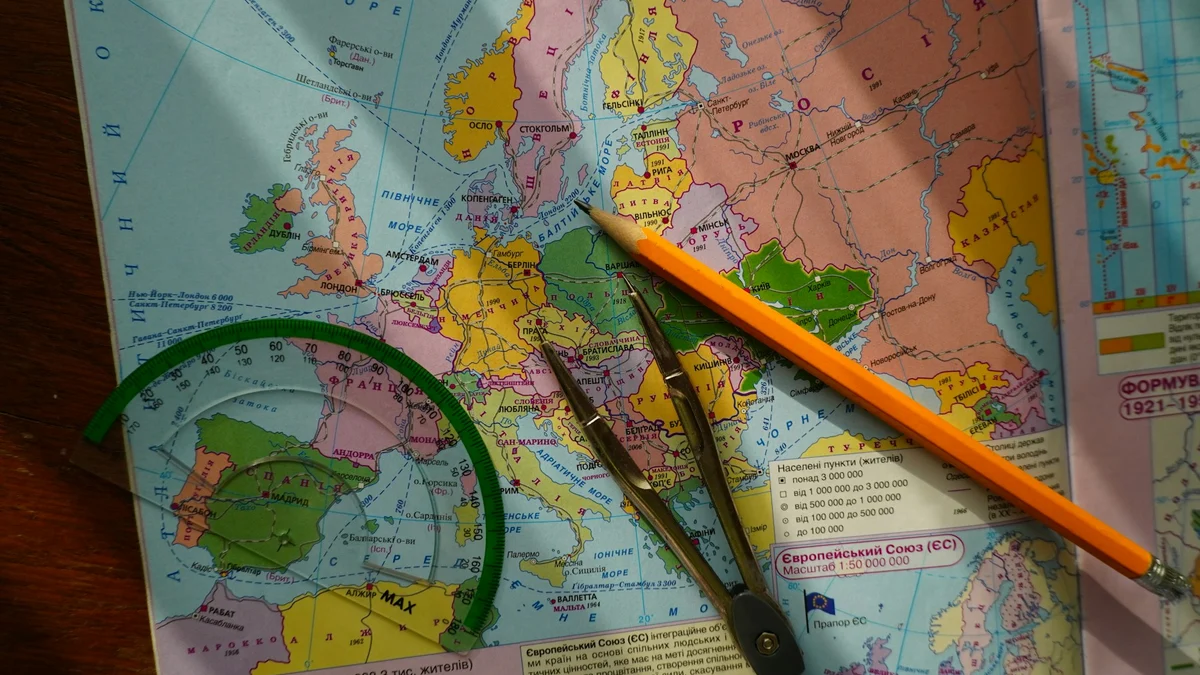
Our original problem gives a 5.2 cm segment on an unscaled map at 1:25000. Find the corresponding actual length in km. Assume a valid linear scale for the stated segment; this exercise does not analyze map projection, curved roads or measurement uncertainty.
We need 100 cm = 1 m and 1000 m = 1 km. The NIST SI-prefix reference gives factors for centi, milli, kilo and other prefixes. A prefix defines a multiplier; it does not decide whether the problem concerns length, area or another quantity.
| Item | This example | Purpose |
|---|---|---|
| Known quantity | 5.2 cm on the map, scale 1:25000 | Distinguish map distance from actual distance. |
| Target | Actual length in km | Specify more than a unitless number. |
| Assumptions | Valid linear scale, unchanged map size | Check the scale condition if display or print size changes. |
Write each conversion factor in full
The scale first converts map length to actual length in the same unit: 5.2 cm × 25000 = 130000 cm. Do not suddenly label that result 130000 m. A changed number does not authorize a changed unit.
Multiply by 1 m / 100 cm next. The cm units cancel, leaving 1300 m. Then multiply by 1 km / 1000 m, canceling m and leaving 1.3 km. Each of these unit factors equals one because its numerator and denominator express the same length. It changes the unit representation, not the physical quantity.
5.2 cm × 25000 = 130000 cm
130000 cm × (1 m / 100 cm) = 1300 m
1300 m × (1 km / 1000 m) = 1.3 kmReversed units expose a mistaken factor
130000 cm × (100 cm / 1 m)
130000 cm × (1 m / 100 cm)
Find a tenfold error without repeating every step
One map centimeter corresponds to 25000 cm, or 250 m, in reality. Five centimeters should be about 1250 m, so 1300 m for 5.2 cm is plausible. A result of 13 km or 0.13 km deserves investigation. This estimate checks magnitude, without replacing the exact numerical and unit chain.
Reverse the result: 1.3 km = 1300 m = 130000 cm, divided by 25000 gives 5.2 cm. If the calculation does not return the original map length, inspect scale direction, centimeter-to-meter conversion and any mid-calculation unit change. Record the actual check instead of adding an unexplained tick.
| Check | Evidence in this case | Detects |
|---|---|---|
| Units | Only km remains at the end | Inverted factors or missing units. |
| Magnitude | 250 m per map centimeter | Tenfold or hundredfold errors. |
| Reverse conversion | 1.3 km returns to 5.2 cm | Wrong scale direction or combined multipliers. |
Change a condition to test understanding
Variation A uses a 26 mm segment at the same scale. Convert first: 26 mm = 0.026 m; multiplying by 25000 gives 650 m, or 0.65 km. Do not treat 26 mm as 26 cm. Write an independent unit chain before comparing with this explanation.
Variation B converts 1 cm² to m². Since 1 cm = 0.01 m, squaring both sides gives 1 cm² = 0.0001 m². The length relation of 100 becomes 10000 for area. When the target concerns area, a length conversion cannot be copied unchanged.
A. Map segment: 26 mm; scale: 1:25000; find actual km.
Write known quantity, target unit, unit chain, magnitude and reverse check.
B. Convert 1 cm² into m².
Explain why the length factor is squared.
Finally record the first inconsistent step, if any.Turn the first error into the next practice condition
If variation A was wrong, record whether mm became cm, scale multiplication became division, or the final meter-to-kilometer step failed. Each cause needs a different practice variation. Copying only the final answer loses that information. Use the first-wrong-step review to preserve your original work and correction reason.
For graph questions, use the axis and data-evidence checks to read units first. Correct conversion cannot repair a mistaken axis, scale assumption or measured object. Our exact supplied values illustrate the method; real measurements also require precision and scale-condition checks.
Before the next independent exercise
- Attach units to known quantities and targets, distinguishing map length, actual length and area.
- Use equal-quantity factors that cancel the old unit.
- Give concrete magnitude and reverse-check evidence.
- Record the first inconsistency rather than only the corrected answer.
Common questions
Why can a conversion use a fraction?
When numerator and denominator represent the same quantity, such as 1 m and 100 cm, the factor equals one. It changes the unit expression, not the length.
Is a correct number without a unit complete?
This exercise requires an actual length in a target unit. Without units, meaning and the conversion path cannot be checked. Complete them before acceptance.
Does area use the same decimal shift as length?
Do not reuse the length multiplier unchanged. Unit powers participate: 1 cm² = (0.01 m)² = 0.0001 m².