The learning goal
Keep fractions or full intermediate values where possible, then round according to the final requirement. Decimal places and significant figures differ. Staged settlement and integer decisions can require other rules. Positive examples here explicitly use ordinary half-up rounding, without claiming a universal software default.
0.67 is not an exact alternative spelling of 2/3
Original exercise: three segments each measure 2/3 meter. Retaining fractions gives(2/3)×3=2 meters. Replacing each with 0.67 first gives 2.01 meters. The discrepancy comes from changing the input early, not a failure of multiplication.
The NIST unit-conversion guidance recommends retaining intermediate quantities and rounding the final result. This article applies that principle to a learning exercise. A task explicitly requiring per-item settlement, integer rounding or a particular recording standard retains its own rules.
| Path | Intermediate value | Final calculation | Interpretation |
|---|---|---|---|
| Keep the fraction | 2/3 | 3×2/3=2 | Exact arithmetic for the stated exercise |
| Round each input first | 0.67 | 3×0.67=2.01 | Input substitution changes the result |
| Display two decimals | Internally still 2/3 | Finally 2.00 | Display precision need not change working values |
Two rounds can move a value across a boundary
Round the positive number 1.2451 to one decimal place. Directly, the hundredths digit is 4, giving 1.2. First rounding to two decimals gives 1.25; rounding that value to one decimal with ordinary half-up gives 1.3. This is the double-rounding discrepancy in the example.
The convention is explicit. Software can use half-to-even, decimal-specific or binary floating-point rules; negative values and exact ties also require definitions. No unspecified software default supplies the reference answer here.
A displayed intermediate can become a different input
1.2451→1.25→1.3, so the one-decimal answer is 1.3.
Apply the final requirement directly to the original:1.2451→1.2.
“Two places” is an incomplete instruction
12.345 becomes 12.35 to two decimal places, but 12 to two significant figures. For 0.004560, two significant figures gives 0.0046 while two decimal places gives 0.00. The precision differs substantially.
Significant figures help express measurement precision, but appearances alone do not establish uncertainty. An exact count of three segments is not limited to one significant figure simply because 3 has one written digit. Identify definitions, exact counts and measurements, then follow the relevant course or task convention.
| Input | Requirement | Result here |
|---|---|---|
| 12.345 | Two decimal places, half-up | 12.35 |
| 12.345 | Two significant figures | 12 |
| 0.004560 | Two significant figures | 0.0046 |
| 0.004560 | Two decimal places | 0.00 |
Preserve a separate calculation line
Keep raw values, working arithmetic and the displayed answer separately. Hand calculations can retain fractions; calculators can retain an unrounded stored result. In spreadsheets distinguish cell display formatting from an explicit ROUND-type formula. Do not transcribe a short display and silently relabel it as the exact input.
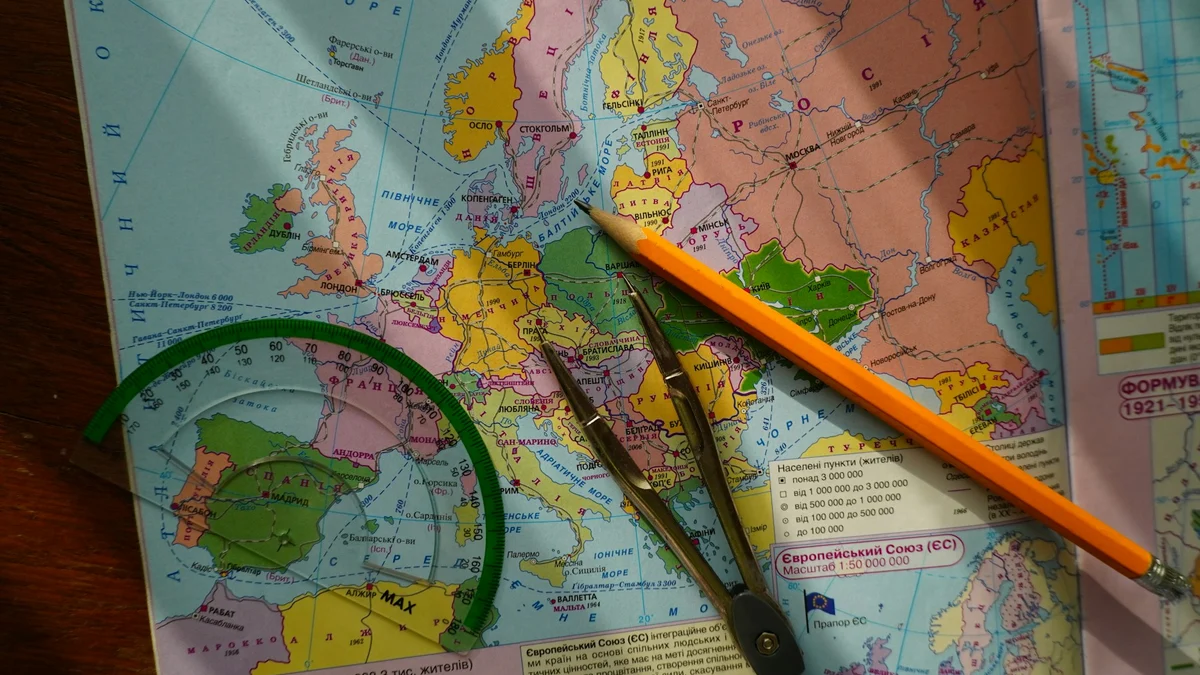
Check units and scale using unit cancellation and map-scale verification. For fraction division, first understand capacity, remainders and reciprocals, then choose the final display. Decimal appearance should not obscure the operation’s meaning.
- Retain raw values and their source; identify decimal-place, significant-figure or integer requirements.
- Keep fractions or suitable original precision instead of repeatedly substituting displayed values.
- Apply the required final rule once to the unrounded result, stating units and convention.
- Recalculate from the original expression and find the first substituted intermediate if answers differ.
A calculated 2.4 items may require a separate decision
Integer treatment can be operational. Boxes needed to contain every item may round up, while complete filled bottles may round down. Those choices come from the task, not a generic decimal-place rule. If the task explicitly cuts each segment to 0.67 meter,2.01 meters is the result of that different input.
This article does not prescribe a universal measurement or financial rounding standard. Separate the scenario rule, mathematical quantity and presentation so you know which layer needs repair.
Before writing the final answer
- Original inputs were not silently replaced with shortened decimals.
- Decimal places, significant figures and integer decisions are distinguished.
- Undefined ties, negative-number behavior and software conventions are checked.
- The answer has units and can be reproduced from the original expression.
Common questions
Does a calculator display of 0.666667 already imply lost internal precision?
Displayed and internal precision may differ. Continuing with the stored result differs from re-entering the shortened display. Check the actual software behavior.
Is keeping four decimals at every step always safe?
No universal guarantee follows. The effect depends on operations, scale and final requirements. Retain exact fractions when practical.
What if every item must be settled to cents before summing?
Follow that explicit staged rule and record it. Do not silently replace it with one final rounding of the total. The general calculation examples here do not override that convention.