The learning goal
Ask whether watering time was assigned randomly or changed together with light, soil and starting size. An observed mean difference can be correct without establishing its cause. Preserve the observation and its scope, identify unknowns and propose a design capable of distinguishing explanations.
Which sentence can these two groups support?
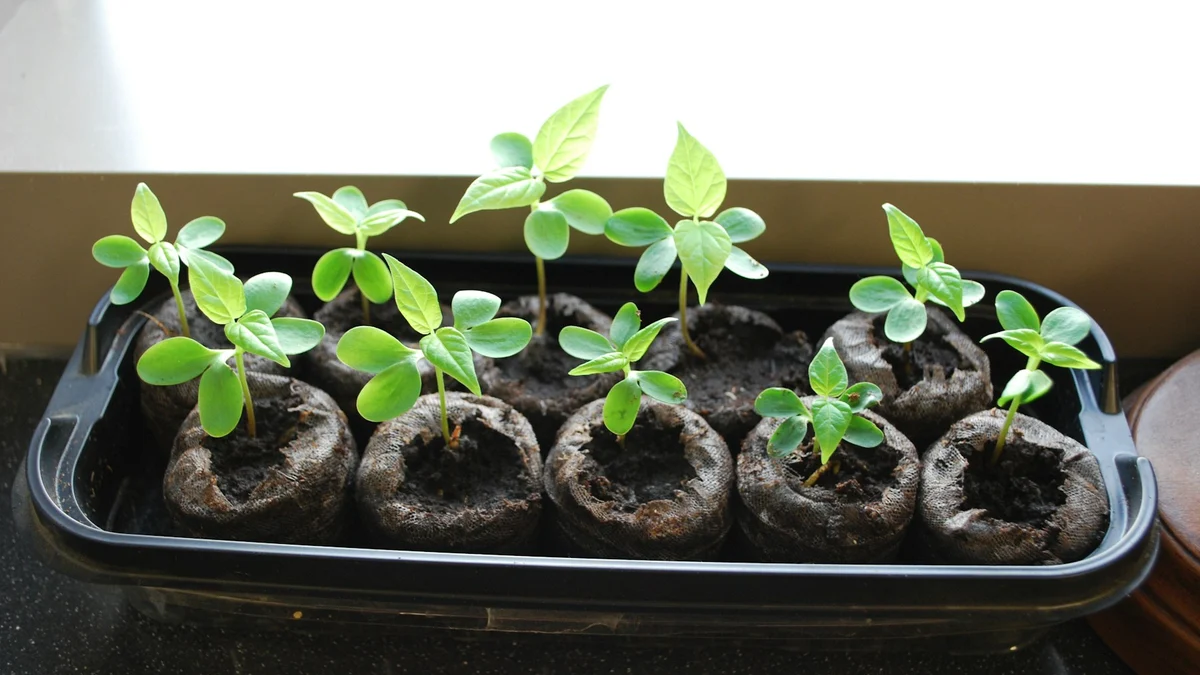
All six seedlings and values are original teaching constructions, not agricultural findings or growing advice. Group A is near a window and watered in the morning, with final heights of 6, 7 and 8 cm. Group B is farther from the window and watered in the evening, with heights of 2, 3 and 4 cm. Their means are 7 and 3 cm.
The difference is completely reproducible from the table. However, watering time and position change together. The table alone cannot identify the responsible factor. Even a plausible explanation for watering-time effects is not evidence that this design isolated that effect.
| Group | Position and watering | Heights, cm | Mean |
|---|---|---|---|
| A | Near window; morning | 6, 7, 8 | 7 |
| B | Farther from window; evening | 2, 3, 4 | 3 |
Separate observation, alternatives and the causal question
The OpenStax experimental-design chapter explains lurking variables and the role of random assignment. We use those basic concepts here; the seedling scenario and numbers are our editorial exercise, not a textbook study or an institutional finding.
Keep the observation first: group A is taller on average in these six values. Then list alternatives: light differs and starting size is unrecorded. Finally ask the causal question: with otherwise comparable arrangements, would changing watering time change growth? These sentences do different evidential jobs.
Three sentences, three levels
Observation
Describe the supplied values accurately without generalizing beyond them.
Alternative explanation
Identify changing or unrecorded factors as hypotheses to investigate.
Causal question
Ask about an intervention whose effect needs an appropriate design.
Make the comparison answer a clearer question
As a design exercise, begin with comparable plant types, starting stages, containers, soil and water amounts. Randomly assign watering time within comparable positions, preventing all morning plants from landing near the window. Random assignment reduces systematic allocation differences; it does not guarantee identical characteristics in every small group.
Define the outcome beforehand too. Is it final height or height gained over the same interval? Different starting heights make those different questions. Record dates, units and missing-data rules rather than switching metrics after seeing the result. We have not calculated a required sample size or claimed this outline is sufficient for formal research.
Improve the question before calculating
Compare near-window morning plants with distant evening plants and attribute every difference to watering time.
Randomize watering time within comparable positions, record starting height and predefine growth over the same interval as the outcome.
More plants do not automatically mean more independent information
Seedlings in one tray can share water and location. Many plants in that tray are not automatically many independent repetitions of an environment. Record what actually receives the assigned treatment: plant, pot or tray. Then identify the appropriate observational unit.
This also explains why a large sample alone cannot establish causation. More data from the same arrangement may describe its difference more precisely while retaining the same confounding. Asking about design and units before learning a more elaborate test makes it easier to understand what the formula is about.
Write a traceable summary without erasing the observation
A cautious summary need not deny everything. It can report a 4 cm mean difference while noting that position and watering time changed together. Do not reverse the mistake and claim that confounding proves watering time has no effect. That also exceeds the evidence.
Use the confidence-versus-evidence review method: write your judgment, identify what the table directly supports and mark the inference. When reading conditional proportions, pair this with the conditional-probability direction check to avoid rewriting one observed relationship as a different proposition.
Keep the information and retract the overclaim
Morning watering makes seedlings grow an extra 4 cm on average.
In these fictional values, the near-window morning group has a final-height mean 4 cm higher; differing positions prevent attribution to watering time alone.
Transfer the method to another learning scenario
Try “students who volunteered for tutoring scored higher.” Identify possible starting differences, study time and selection reasons before writing a cautious conclusion. This transfer exercise supplies no real student data and implies neither that tutoring works nor that it fails.
A complete self-check needs more than “correlation is not causation.” Name a specific confounder, explain what the observation supports and ask a question that would improve the design. If you can recite the slogan but cannot analyze the comparison, record that gap for another practice session.
Four questions for your own analysis
- Was the behavior or treatment randomly assigned?
- What changed with it, and what was unrecorded?
- Whose values, which time period and which outcome are described?
- Does the conclusion preserve observations without overclaiming or overdenying?
Common questions
Does confounding mean the observed difference is fake?
No. The difference can exist while the design fails to isolate a particular cause.
Does random assignment guarantee identical groups?
No. It reduces systematic allocation bias, but small groups can remain imbalanced. Correct measurement and implementation still matter.
Can a sufficiently large sample turn correlation into causation?
Not by size alone. Design, confounding, timing and defensible assumptions still matter.