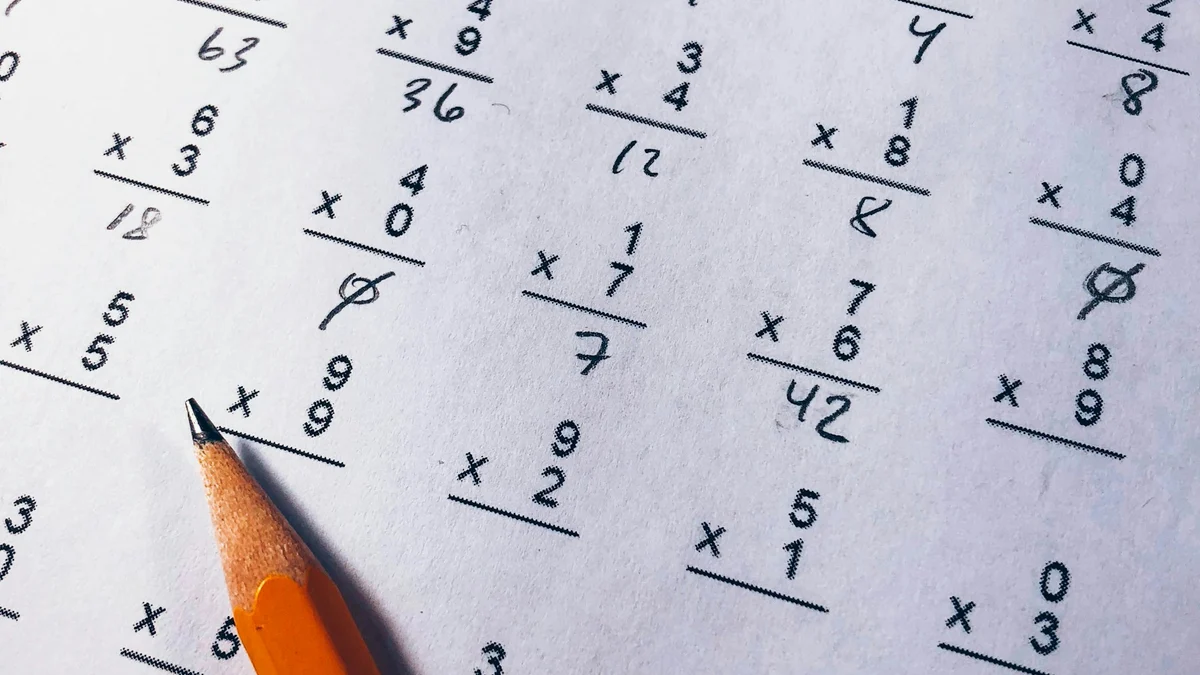
The learning goal
Mix two or three previously learned methods that you tend to confuse. For each problem, identify the target and explain the chosen method before calculating. Separate strategy errors from arithmetic errors in feedback. If a method is still unfamiliar, use examples and a short focused practice first rather than relying on random difficulty.
Practice strategy selection, not constant app switching
IES guidance on study strategies describes interleaving as mixing problems requiring different strategies, making students select and apply a method. We translate that into a personal review routine, not a universal effect guarantee for every subject or learner.
A chapter heading often tells you which formula to use in blocked practice. Mixed problems remove that cue and require reading the question. Observe whether conditions and goals lead you to the right method, rather than counting completed items.
Choose methods you already understand separately. If you cannot explain the formula in a basic problem, return to an example and its reasoning. Mixing unfamiliar strategies can leave you unable to identify the source of failure.
Three original problems: similar numbers, different goals
These are our own practice items, not research test questions. Read the goal first. Length and width appear in both area coverage and frame-length questions, but the methods differ. A proportional price problem does not become an area task merely because two numbers appear.
Write a method-selection sentence before solving, then review the answers. Cover the right-hand column or copy the questions onto paper first so the table itself does not supply the strategy.
| Original problem | Reason for the method | Check calculation |
|---|---|---|
| How much area covers a floor of length 8 and width 3? | Covering a plane calls for area | 8 × 3 = 24 square units |
| How long is the border around a frame of length 8 and width 3? | Distance around the shape calls for perimeter | 2 × (8 + 3) = 22 length units |
| Two equally priced notebooks cost 6. What do five cost? | Constant unit price calls for proportional reasoning | 6 ÷ 2 × 5 = 15 monetary units |
Organize a review around choosing, solving and feedback
- Select a few questions from each of two or three learned methods. Remove headings that reveal the type, while keeping complete conditions and units.
- Arrange a mixed order, such as area, proportion, perimeter, then a new area variant. This is an example, not an optimal fixed formula.
- State the target and method rationale before calculating. Avoid the chapter label and answer key at this stage.
- Review method, calculation and units separately. Add a targeted follow-up for an error, then revisit with new problems after a delay.
Keep three lines for each problem
- Target: what quantity is required?
- Method: which condition supports this choice?
- Review: are strategy, arithmetic and units each correct?
Treat a strategy error differently from an arithmetic error
If you identify the target as distance around a shape but use 8 × 3, revisit method selection. Explain the difference between covering a plane and walking around its border, then compare two problems differing only in their goals. Copying the correct formula alone skips that distinction.
If the method and expression are correct but 2 × 11 is miscalculated, inspect the arithmetic. Record the first failure in a reviewable error log. You need not classify the entire topic as unknown.
A correct answer justified only by “it looks similar” still needs a conditions check. Explain why the method applies and select it in an unlabelled new problem before expanding the mix.
Adjust practice at the point of failure
Wrong strategy
Compare goals and conditions using nearby methods.
Arithmetic error
Locate the first incorrect operation and practice that calculation.
Wrong units
Distinguish length, area and count meanings.
Heading dependence
Use new problems without type labels to check selection.
Check later understanding without promising a score gain
Review after a delay with new numbers and wording for the same concepts. Record method choices and solutions instead of relying on remembered answers. See adjusting spaced review to understanding for scheduling ideas.
The first mixed session may be slower. That alone does not establish failure, and extra difficulty alone does not establish benefit. Observe later selection on unfamiliar problems. Reduce the number of types when underlying knowledge remains unstable.
This is an adaptable editorial routine, not a research-validated daily quota. Professional courses, language learning and factual recall need material-specific designs. AI can draft variants, but verify answers and applicability with reliable teaching materials or a teacher.
Common questions
Should unfamiliar methods be mixed immediately?
Learn the method and examples first, then mix learned methods. Many unknown problems make errors harder to diagnose.
Does interleaving mean switching subjects randomly?
No. The focus is choosing strategies among problems requiring different methods, not repeatedly changing apps or tasks.
Is a slower session evidence that it does not work?
Speed alone is insufficient. Check strategy selection and solutions on later new problems while addressing missing foundations.